Book rooms & suites
Select Dates
Guests
Adults
0
Children
0

.avif)
There was a great deal of excitement in the Beaufort Room and the Thames Foyer one night in July 1923. That evening, the famous American composer George Gershwin had arranged to perform the British premiere of a new work, Rhapsody in Blue, on The Savoy’s famous rising cabaret floor, accompanied by The Savoy’s own dance band, The Savoy Orpheans. This important event was to be broadcast live by the BBC, and up and down Britain households were carefully tuning their radio sets in anticipation.
The restaurant was packed with guests and celebrities, all dressed in their finest evening clothes, and a buzz of expectation hung in the air. As the time for the broadcast drew closer, panic spread among the musicians. Gershwin was nowhere to be found, and there were only minutes to go before the broadcast was due to begin. Staff rushed to the American Bar and the restaurant to see if he was there, while the second pianist, Carroll Gibbons, quickly ran through Gershwin’s piano part, just in case he was required to take his place.
Barely a minute before the broadcast began, Gershwin suddenly appeared on stage. He launched into his new composition with apparent ease, while Carroll Gibbons breathed a sigh of relief that, with so little rehearsal time, he did not after all have to stand in for Gershwin.
.avif)
One September evening in 1938, Mr Churchill was at The Savoy to attend a dinner of his favourite gathering, The Other Club. These dinners were normally convivial and relaxing, but it was the day of the Munich Conference, and in contrast the atmosphere that evening was highly charged. Discussion throughout the night focused on the outcome of the Munich Conference — the decision by the leaders of Britain, France and Italy to back down and allow Germany to annex certain parts of Czechoslovakia.
An emotional Mr Churchill ended the evening by declaring that at the next General Election he would speak on every Socialist platform in the country against the Government. The sequel to the sacrifice of honour, he warned, would be the sacrifice of our people’s lives.
After the dinner, Mr Churchill was escorted by the General Manager up to the Front Hall. As they passed the Thames Foyer, they could hear the cheerful sounds of people enjoying themselves. Mr Churchill stopped abruptly in the doorway and stared into the lively room. Then, as he turned away, the General Manager noticed a tear in his eye.
“Those poor people,” said Mr Churchill. “They little know what they will have to face.”
.avif)
Singer and actress Alice Delysia began her career as a chorus girl at the Moulin Rouge in Paris, but it was in London where, shimmering in sequinned gowns, she achieved her greatest success, starring in some of C. B. Cochran’s most glittering musicals.
Temperamental and the very embodiment of Parisian chic on stage, in reality Miss Delysia liked to live quietly at The Savoy. From Biarritz, her mother wrote regularly, reminding her to go to bed early and not forget her hot milk.
On one of her visits to The Savoy, Miss Delysia returned from a tour of foreign lands with over a dozen pieces of luggage. Among them, a wicker basket was taken up to her suite. Before the porter could close the door, the lid lifted slowly. Two large snakes slid out and began to slither along the corridor, flicking their unfriendly tongues.
A chambermaid fainted. A waiter called Reception and suggested an urgent call to the Natural History Museum, while a resourceful page applied his basic knowledge of hypnotism. Meanwhile, a porter who had previously served as a valet in India rushed to the pantry and armed himself with a pair of fire tongs. With considerable skill, he popped the unpleasant guests back into their basket, firmly secured the lid, and peace once more reigned on the sixth floor.
At the management’s insistence, Miss Delysia reluctantly agreed to donate her snakes to the Royal Zoological Society. That evening, when she returned to her suite after supper, she found — placed carefully on the tray with her hot milk — a sparkling silver crystal snake brooch, pinned to a notecard from the General Manager, Mr Gelardi. The simple message read: “They have settled in well. Thank you for your understanding.”
.avif)
In his younger days, Mr Sinatra was legendary for partying after his concerts. After a one-man show at the Festival Hall, he once returned to The Savoy and spontaneously invited more than thirty people back to the hotel for a party. It began in the early hours of the morning and ended some hours later with a sumptuous champagne breakfast. Mr Sinatra then went up onto the roof of the hotel to take photographs of the legendary river view in the morning sunshine.
In later years, as Mr Sinatra grew older, he preferred to wind down more quietly after his shows. In the early 1980s, he returned to London to play a series of concerts and once again stay at The Savoy, his London home-from-home. He was delighted to reunite with his old friend Joe Gilmore, Head Barman of the American Bar, where he would slip in for a drink or two on his way out of the hotel to the concert venues. “I’ll sing the song ‘Set ’Em Up, Joe’ especially for you, Joe,” he told the barman — and he always did.
Just as in years gone by, Mr Sinatra would return to The Savoy in the early hours of the morning, but these days he would sit at the white piano in the Thames Foyer and unwind by playing and singing for his own pleasure, and for that of any night staff who happened to be passing through.

One day in 1898, Woolf Joel, a regular Savoy guest who was due to leave for South Africa at the end of the week, decided he wanted to say goodbye to his London friends and thank them for their hospitality while he had been in London. He discussed his idea with César Ritz, who suggested the Pinafore Room and undertook to make the arrangements, including a special Escoffier menu for him and his thirteen guests to enjoy.
On the day of the dinner, one of Mr Joel’s guests had to cancel, and thirteen sat down to dine. Towards the end of the evening, Mr Woolf left the room to check that the arrangements had been made for his journey the following day to Southampton. As he rose from the table, he laughed when his guests reminded him of the old superstition that when thirteen are seated together, the first to leave the table is destined to die.
A few weeks later, shocking news reached The Savoy: Woolf Joel had been shot dead in his office in Johannesburg. Ritz was stunned and, encouraged by Joel’s friends, immediately began to consider what The Savoy could do to assist superstitious guests in the future.
After much discussion, it was decided that if there happened to be thirteen guests at a party, a member of the hotel staff would be recruited to sit at the table. However, for obvious reasons, this proved unhelpful when guests wished to relax or discuss private matters.
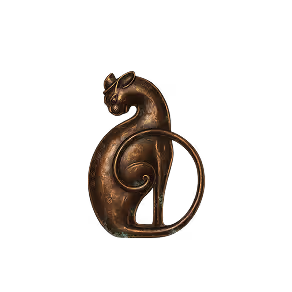
A better solution was agreed upon several years later, in the mid-1920s, when the Directors commissioned designer Basil Ionides to create a three-foot-high cat, carved from a single piece of plane tree. Christened Kaspar, the cat would sit on the fourteenth chair, with a napkin tied around his neck, whenever a party of thirteen sat down together. Alongside his fellow guests, Kaspar would be served the entire meal, dish after dish, complete with the full complement of Savoy china, glassware and cutlery.
This Savoy tradition continues today, and Kaspar remains a regular diner in the Private Rooms corridor.
.avif)
Savoy Court is one of London’s small but delightful exceptions to the rule. While the rest of the city keeps firmly to the left, cars arriving at The Savoy drive on the right-hand side of this short, elegant approach. The tradition dates back to the early days of motoring, making it easier for well-dressed passengers to step directly onto the pavement from the left-hand side of their cars. It’s a subtle detail most people don’t expect, but it perfectly captures The Savoy’s spirit: practical, theatrical, and quietly confident in doing things its own way.
.avif)
Fred and Adele Astaire once turned the roof of The Savoy into an open-air stage, dancing high above the Thames with the city spread out beneath them. At a time when they were thrilling London audiences with their wit, elegance and perfectly timed steps, the rooftop became a place to rehearse, play and show off their extraordinary chemistry. Passers-by below had no idea that two of the most exciting performers of the era were gliding across the rooftop, tapping and twirling against the skyline. It was a moment of pure, carefree brilliance — the Astaires doing what they did best, and The Savoy quietly playing host to yet another unforgettable chapter in its story.
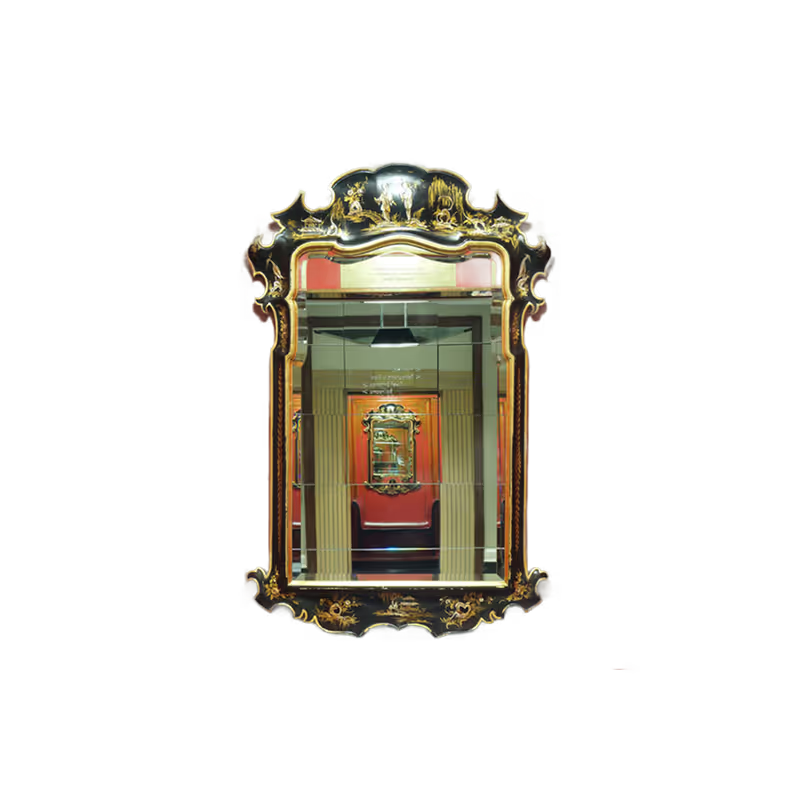
The red lift at The Savoy has always been more than just a way to get upstairs — it was a glimpse into the future. When it first opened, it was the first electric lift in London, and people didn’t even call it a lift yet; it was known as an “ascending room.” The journey to the top of the hotel took around seven minutes, which felt astonishingly fast at the time, so fast that many guests weren’t sure their bodies would cope. Travelling upwards at that speed was completely unfamiliar, and some found the experience overwhelming. To reassure shaken passengers, the lift operator was famously equipped with brandy and smelling salts, ready to revive anyone who felt faint after the ride. Today, the red lift remains a charming reminder of The Savoy’s long history of turning bold innovation into unforgettable theatre.
.avif)
Lanterns flickered along the boardwalk as George Kessler made his way to a silk-lined gondola moored at the end. An American financier and one of The Savoy’s most loyal guests, Kessler was renowned for his extravagant parties and meticulous attention to detail. To celebrate his birthday, he invited twenty-three close friends and set out to astonish them.
As guests arrived, they were asked to step from their carriages before entering the courtyard. Walking through the archway, they were met with an extraordinary sight: the courtyard — now the Lancaster Room — had been completely flooded. Gondolas replaced carriages, swans drifted on the water, and waiters dressed as gondoliers guided guests past painted Venetian backdrops and thousands of carnations.
Just when it seemed the evening could offer no more surprises, Kessler directed his guests’ attention to The Savoy’s main staircase. As Enrico Caruso sang beneath lantern light and a paper moon, a baby elephant appeared, carrying a five-foot birthday cake, followed by the release of one hundred white doves. Laughter and applause filled the hotel. The spectacle was flawless — and George Kessler smiled, knowing The Savoy had delivered once again.
.avif)
Because of Craddock’s loyalty to The Savoy and his legendary art of mixing, it was decided his legacy should remain forever! So, it was with that in mind that, during some refurbishment works in the bar, the Directors asked Craddock to mix one of his favourite cocktails (the White Lady) but to leave it un-poured in the cocktail shaker. A little bewildered by the request, Craddock obliged and just as he was shaking the perfectly combined 1/4 Lemon Juice, 1/4 Cointreau and 1/4 Dry Gin, his team, the Directors and the senior management joined him along with a photographer. Even more bewildered, Craddock watched as Rupert D’Oyly Carte ceremoniously drew back a dustsheet and pointed to a gap in the concrete – “a perfect cocktail shaker sized gap” was his comment! Craddock laughed, and, placing the shaker gently down with the aid of a trowel, watched as the builder poured over the remaining concrete.
.avif)
Monet began his famous Views of the Thames during three long stays at The Savoy in 1899, 1900 and 1901, spending days soaking in the river view from his suite and watching the light change over the water. He painted in the cold, the fog, and the quiet early mornings, capturing impressions rather than finished works. Those London moments stayed with him long after he left - back in his studio in Giverny, north of Paris, he returned to the sketches and memories, slowly turning them into the atmospheric paintings we recognise today.
.avif)
Joe Gilmore was one of the longest serving Head Barmen at The Savoy’s American Bar. He started as a trainee barman in 1940 and was appointed Head Barman in 1955, a position he held until he retired in 1976. Over his years as Head Barman, Joe invented numerous cocktails to mark special events and important guests, a longstanding tradition in the American Bar. He invented cocktails in honour of Royalty, politicians and celebrities including Prince Charles, Princess Anne, Queen Elizabeth The Queen Mother, Prince Andrew, Sir Winston Churchill and American Presidents Harry S. Truman and Richard Nixon. One of the most notable events to be marked with a Joe Gilmore cocktail was the first moon landing by Apollo 11 on 20th July 1969. Joe created The Moonwalk, which The Savoy sent off to NASA in a flask. After the safe return of the Command Module to Earth on 24th July 1969 and the release from quarantine of the three astronauts, Neil Armstrong, Michael Collins and ‘Buzz’ Aldrin three weeks later, the Moonwalk was the first drink they enjoyed together.
Behind every suite, every toast, every shimmer of the Thames, a story waits to be told. Discover the legends, secrets, and small eccentricities that make The Savoy the timeless icon it is today.
For bookings and bespoke requests, our reservations team is here to help.


Select Dates
Select a Restaurant
The Savoy’s world-famous Afternoon Tea brings a century of tradition to The Gallery — warm scones and over 30 exceptional teas, coming together in an experience that stays with you far longer than an afternoon.
Gallery brings a vibrant energy to The Savoy — an elegant all-day dining space where British heritage, modern style and warm service come together from breakfast through to late-night cocktails.
The American Bar is the original cocktail bar in London and one of the most renowned in the world. Serving classics with a twist, new and vintage creations – the American Bar is an icon in cocktail history and has played host to legendary bartenders.
Beaufort Wine Bar redefines wine discovery in one of London’s most celebrated hotels. Guided by Head Sommelier Romain Audrerie, our cellars bring together an extraordinary collection of over 250 wines from 18 countries across six continents, with over 120 served by the glass.
Restaurant 1890 brings together meticulous service, modern tasting menus, an elegant bar space, and a world-class wine list, guided by craft and precision.
Gordon Ramsay’s famed Savoy Grill, with its Art Deco style and Hollywood glamour, presents twists on the traditional, with an iconic British and French-inspired menu alongside an exceptional wine list.
The River Restaurant presents stylish, relaxed all-day dining in The Savoy, with a vibrant, produce-led menu that’s shaped by the seasons and tides.